Look for a clean passage
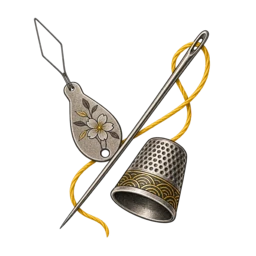
Thread the needle and pull a short length back and forth through the eye by hand. Any rough catch, scraping sound or visible fibre damage is a reason to try another needle.
An eye that is too small compresses a full thread and can make the needle difficult to pull. An eye that is too large may leave an unnecessarily wide hole in fine fabric.
Consider thread structure
Soft, loosely twisted sashiko thread can show damage sooner than a compact sewing thread. Divisible floss also behaves differently because individual strands can separate at the eye.
Use the same needle for a short swatch and inspect the strand at the end. Fraying in the middle of a length often begins at repeated contact with the eye.
Replace before the break
A needle does not need to be visibly bent to become a problem. If the thread starts breaking, the eye feels rough or the needle stops gliding, retire it from fine work.
Keep worn needles in a separate container so they are not mixed with new ones. A small label can note whether a needle is reserved for rough denim or no longer safe for thread.