
Identify the resistance
The common causes are too many layers, a needle that is too fine for the job, a seam crossing or a point that is meeting the fabric at an awkward angle. Stop when the pressure rises.
Do not straighten a bent needle and return it to fine work. Even a small change in the shaft can make the eye rough or the point travel sideways.
Change one factor at a time
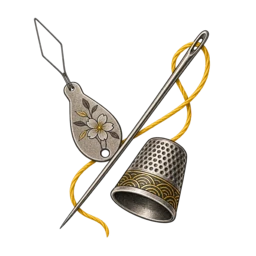
Try a shorter or stronger needle, reduce the folded layers or use a thimble on a small swatch. This shows whether the issue is the tool, the cloth or the technique.
If the same needle bends across several suitable swatches, inspect it closely and replace it. Manufacturing damage or repeated wear may be the cause.
Protect the work and hand
A bent needle can catch the thread and make you pull harder, creating a cycle of more damage. Put it aside as soon as it stops moving cleanly.
Keep a small range of needle sizes available for changing conditions. Choosing a better match is safer and often faster than forcing one needle through every project.